Remember.
Always.
A gentle nudge. A familiar voice. A moment of clarity.
ZAKR is a closed-loop neural memory augmentation platform - a lightweight wearable and on-device AI system designed to help reinforce the neural pathways behind memory encoding and recall, in real time. Built first for people living with Alzheimer's disease and mild cognitive impairment, and for the families who walk alongside them.
One closed loop, five quiet steps
ZAKR follows a continuous five-stage process to sense, understand, store and - when it's genuinely needed - gently help bring a memory back.
Acquire
ZAKR listens and senses gently in the background - noticing conversations, places, faces and routines without ever interrupting the moment.
→Encode
An on-device model decides what's meaningful and worth holding on to, turning it into a secure memory record in a fraction of a second.
→Store
Each memory record is sealed with hardware-grade encryption and saved safely on the device itself - nothing is lost, even if it's switched off.
→Detect
ZAKR continuously compares what it senses against a baseline built just for that person, watching quietly for moments of difficulty.
→Replay
When it's appropriate - and only within carefully governed limits - ZAKR offers a gentle nudge: a familiar voice, sound or cue to help the memory surface.
Designed around people, not just protocols
Keeps Memories Alive
Helps recall the moments that bring joy, identity and meaning back into focus.
Strengthens Connections
Supports easier conversations, closer bonds, and less day-to-day frustration for families.
Empowers Independence
Helps people do more on their own, with a quiet sense of confidence.
Supports Brain Health
Continuous, passive monitoring helps keep the mind engaged over time.
Built With Trust
Every memory record stays encrypted, on-device, and is never shared without consent.
The NV-Band, at a glance
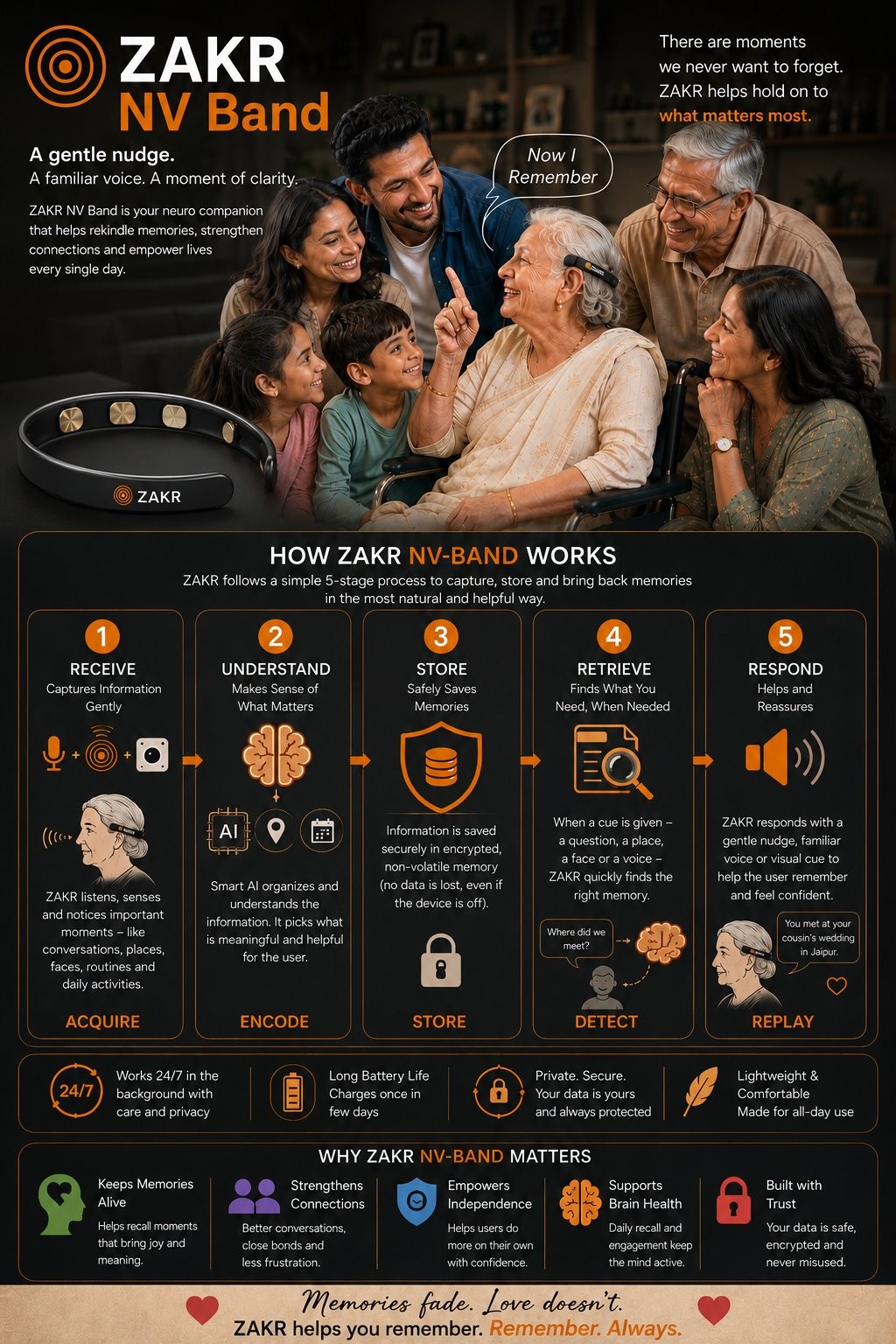
A single page from our printed brochure - the same five-stage loop and everyday benefits described above, designed for families meeting ZAKR for the first time.
- ●Works quietly in the background, 24 hours a day, with care and privacy.
- ●Long battery life - charges once every few days.
- ●Private and secure. Data stays the user's own, always protected.
- ●Lightweight and comfortable, made for all-day wear.
Built by people who set out to solve this
ZAKR was founded to close one of the most painful gaps in medicine today - the steady loss of memory and identity that comes with Alzheimer's and related conditions.

Hazeem S
Hazeem S is the Founder and Inventor of ZAKR Neurotechnology, leading the company's vision to advance safe, ethical, and human-centered neurotechnology.
With over two decades of global leadership experience across technology-driven organizations, including Microsoft, he brings expertise spanning strategy, engineering, operations, and innovation. His multidisciplinary background combines Computer Science Engineering, and Business & Leadership Certifications.
Driven by a passion for neuroscience and responsible AI, he founded ZAKR to develop technologies that help preserve memory, protect human dignity, and shape the future of cognitive health.

Muhammed Aamir
Muhammed Aamir is the Co-Founder of ZAKR Neurotechnology, contributing to the development of the company's engineering, product, and technology strategy.
An Electronics & Communication Engineer with experience in AI, data, and enterprise technology, he works across product development, system architecture, and research execution. He plays an active role in translating ZAKR's intellectual property into scalable products while supporting clinical, academic, and industry collaborations.
Aamir is passionate about building technologies that combine engineering excellence with meaningful human impact.
A platform shaped around dignity, safety and memory
From the underlying neuroscience to the hardware safety architecture and the AI that governs it - every layer of ZAKR is designed with one outcome in mind: helping someone hold on to who they are.
Three patent families. One closed loop.
Every part of ZAKR - the algorithms, the wearable hardware, and the AI that governs it - is independently developed, documented and protected as its own body of work, while operating together as a single closed-loop system. One pre-registered pilot is now underway to test the platform's core scientific hypothesis. See what's validated, in development, or still a research hypothesis →
Neural Memory Packet System
The intelligence layer - the algorithms, cryptographic protocols and data architecture that decide what gets remembered, how it's protected, and when it's safe to bring back.
UNDER DEVELOPMENT Architecturally specified and being built now; not yet deployed or independently measured end-to-end.
NV-Band Wearable Platform
The wearable itself - a bilateral, lightweight headset built around a hardware safety stack that no software update, voice command, or unexpected input can override.
AI Governance & Protocol Safety
For the first product, protocol selection runs on a deterministic, clinician-reviewed decision layer - not a generative model. Generative AI is scoped to an assistive, non-dosing role (clinician-facing summaries and documentation), and every protocol, regardless of source, is checked against the same hardware-enforced safety limits before anything is delivered. VALIDATED · architectural
The innovations that make the loop possible
A closer look at the systems working together beneath the surface - each one independently documented, and each one essential to the platform as a whole.
NMRGS
A three-gate governance system - integrity verification, frequency limits, and minimum intervals - that prevents memory replay from happening too often, while never limiting what the person themselves chooses to revisit.
AES v3 - Four-Tier Vault
A progressive authentication system designed to remain accessible across the full course of a progressive condition - so a vault is never permanently locked, even as biometric signatures naturally drift over time.
Neural Memory Packet
A structured, encrypted record created for every memory event - capturing what was sensed, how confident the system was, and exactly how it may (and may not) be replayed. UNDER DEVELOPMENT
EPT-00 Emergency Mode
A dedicated zero-stimulation emergency mode. Voice-activated alerts reach a caregiver instantly - without ever bypassing the hardware limits that keep stimulation safe.
HBCI & QAW Coherence
Composite indices combining cardiac, neural and vascular signals into a single coherence score - used to recognise the moments most worth remembering.
Cognitive Longevity Index
A longitudinal cognitive health score, built passively from seven everyday signal streams - with no test to take, no task to complete, and no clinic visit required.
Cross-Modal Replay
Sound, sight and scent cues synchronised within 50 milliseconds of a stimulation pulse - drawing on published research linking multi-sensory cues to stronger recall.
Federated Learning
The model improves over time using on-device learning with differential-privacy protection - with consent-gated participation and no raw neural data ever transmitted.
Seven-Layer Safety Stack
From a physical kill switch to a passive hardware current limiter, each layer operates independently - so no single software issue can ever compromise safety.
taVNS & cPWV
Gentle auricular nerve stimulation alongside pulse-wave-based vascular monitoring - derived from sensors already on the device, with no additional hardware required.
Bone-Conduction Isolation
A three-layer isolation design keeps audio cues delivered through bone conduction from ever contaminating the EEG signals being recorded at the same time.
Source-Agnostic Enforcement
Whether a stimulation protocol comes from a voice command, a companion app, a clinician, or an emergency trigger - it passes through exactly the same hardware safety checks, with no exceptions.
T18 Gamma Entrainment
A closed-loop 40 Hz gamma stimulation mode that verifies its own effect by reading EEG back in real time - halting automatically if entrainment quality falls below a safety threshold. UNDER DEVELOPMENT Specified and simulated; hardware-in-the-loop verification is scheduled for bench validation.
Architecture D - EEG Foundation Model
A fourth AI deployment option: a pre-trained EEG foundation model fine-tuned via low-rank adaptation on the person's own consent-gated memory data.
PESI - pTau217 Electrophysiological Surrogate Index
An EEG-derived composite score, computed from oscillatory and connectivity features, designed as a candidate electrophysiological surrogate for plasma pTau217 - intended for future correlation studies alongside blood-based assays, not as a replacement for them.
Glymphatic Clearance Index
A wearable-derived signal, computed from sleep-stage EEG and pulse-wave data, designed to track the brain's overnight clearance processes over time.
Federated Perturbation Export (FPEP)
A consent-gated, differential-privacy-protected, physician- and IRB-authorised pathway for contributing anonymised stimulation-response data to external research models - never raw neural data.
EIS Parenchymal Resistance (R_P)
A non-invasive electrical-impedance measurement using the same scalp electrodes, fitted to an established bioimpedance model to derive a proxy for brain tissue resistance over time.
Thirty future directions, already mapped
Beyond the platform shipping today, ZAKR has charted thirty future innovation directions - extensions of the same closed-loop foundation into new conditions, new hardware forms, and new research infrastructure.
Theta/gamma entrainment · Glymphatic monitoring · Neuroplasticity tracking
Post-quantum vault migration · Zero-knowledge proofs · Distributed identity anchors
Constitutional alignment · Adversarial defence libraries · Regulatory-ready model cards
Stroke rehabilitation · PTSD support · ADHD attention regulation · Chronic pain
Privacy-preserving EEG biobank · Clinical trial endpoint tooling · Population baselines
In-ear form factor · Sub-30g single pod · Flexible electrodes · Wireless charging
Independently reviewed for novelty
Each layer of the ZAKR platform - the intelligence layer, the wearable hardware, and the AI governance system - has been independently searched against the global patent and scientific literature, with no combination of these systems found in any prior work reviewed to date.
Three layers. One closed loop. Under 250 milliseconds.
ZAKR is built as three independent layers working in concert - AI governance on top, the intelligence layer in the middle, and purpose-built hardware underneath. Each layer can be understood, tested and certified on its own, while the platform behaves as a single, fast, closed loop.
Deterministic decisions for MVP, with hardware having the final word
The first product selects stimulation protocols through a deterministic, clinician-reviewed decision layer - not a generative model. Generative AI plays an assistive role only (explanation, documentation, clinician-facing summaries) and is kept out of the dosing decision path. Every protocol, regardless of source, is checked against the same hardware-enforced limits before it can ever reach the wearable.
Encoding, governing and protecting every memory
On-device inference turns raw signals into structured, encrypted memory records, governs how and when they may be replayed, and keeps a four-tier biometric vault accessible for life - all without sending anything off the device.
The NV-Band - sensing, stimulation and safety in one wearable
A bilateral, lightweight headset combining multi-channel neural sensing, gentle stimulation, and a seven-layer hardware safety stack that operates entirely independently of any software.
From sensing to a gentle cue - in under 250 milliseconds
Every stage of the loop happens on-device, in real time. Detection runs continuously in the background; the entire response completes in well under a quarter of a second.
Multi-channel neural sensing and ambient audio capture, with on-device noise rejection.
On-device inference structures the moment into an encrypted memory record.
The record is sealed with hardware-grade encryption inside a certified secure element.
Ongoing comparison against a personalised baseline, watching for moments of difficulty.
A governed, multi-sensory cue is delivered - only once every safety check has passed.
A wearable built for all-day, every-day use
Comfort and safety were treated as first-class requirements from the start - because a device that helps with memory only works if someone is willing to wear it.
| Form factor | Bilateral wearable arc |
| Total weight | ≤ 60 g |
| Sensing | 8-channel neural + cardiac + vascular + motion |
| On-device inference | < 10 ms per cycle |
| Security | Certified hardware secure element |
| Connectivity | Low-energy wireless, on-device first |
| Battery life | Multi-day, fast recharge DEV |
| Thermal comfort | Passive buffer, skin-safe during extended wear |
| Water & sweat resistance | IPX5 |
| Stimulation ceiling | Hardware-limited, software-independent |
Seven independent layers. No single point of failure.
Each layer below operates on its own - most without any reliance on software at all. A failure, bug, or unexpected input at any one layer cannot defeat the layers around it.
A hardware switch that immediately and irreversibly halts all stimulation, independent of any software state.
Voice commands are only accepted after a deliberate, sustained activation phrase - reducing accidental or adversarial triggers.
The device cryptographically verifies its own safety configuration against a trusted reference before acting on any instruction.
Every proposed protocol - type, waveform, placement and ramp rate - is checked against an approved reference library of registered configurations.
Absolute, hardware-enforced limits on current, frequency, session length and sessions per day - applied identically to every source.
A passive component physically caps stimulation current, regardless of any other failure in the system.
Stimulation and sensing circuitry remain electrically isolated from one another at all times.
A vault that stays accessible - for life
Memory naturally changes how a brain's signals look over time. ZAKR's authentication system is designed around that reality, with four progressive tiers that ensure no one is ever permanently locked out of their own device.
A personal neural signature, established over multiple sessions and refreshed over time as the baseline naturally evolves.
Additional signatures captured at intervals, each independently capable of unlocking the vault on its own.
A secondary biometric fallback, used only if neural-signature matching is temporarily unavailable.
A clinician-assisted override that always grants access to essential medical records - regardless of how much biometric drift has occurred.
Built on published neuroscience, not novelty for its own sake
Every subsystem inside ZAKR is grounded in a specific body of published research - from how memories are encoded and reconsolidated, to how multi-sensory cues and heart-brain coherence influence recall. The platform's contribution is bringing these findings together into a single, real-time, on-device loop.
Network-Level, Not Single-Neuron, Memory
Memory is treated as a property of distributed neural networks, not isolated cells. Early Alzheimer's disrupts these networks without erasing them entirely - ZAKR targets surviving network dynamics during retrieval, rather than acting on individual neurons.
Phase-Amplitude Coupling & Personal Baselines
Continuous monitoring of phase-amplitude coupling - a well-studied marker of memory encoding - compared against a slowly-updating personal baseline, rather than a fixed population threshold. RESEARCH HYPOTHESIS Paper 1, now in progress, is the first test of this claim in ZAKR's own hands, pre-registered with explicit kill criteria before any efficacy claim is made.
Memory Reconsolidation
Each time a memory is recalled, it briefly becomes changeable again. ZAKR's replay governance reflects this - limiting how often and how soon a memory is reinforced.
Multi-Sensory Cueing
Combining sound, sight and scent around a single moment of recall draws on research showing multi-sensory cues can meaningfully improve memory retrieval.
Heart-Brain Coherence
Cardiac, neural and vascular signals are combined into a single coherence measure - built on a longstanding research tradition linking heart rhythms and brain state.
Passive Cognitive Monitoring
A longitudinal cognitive health score, computed from everyday physiological signals - without requiring a cognitive test, a clinic visit, or active effort from the user.
Slow-Wave Sleep Support
Gentle, phase-locked stimulation during deep sleep, informed by research on slow-oscillation stimulation and its role in overnight memory consolidation.
The literature ZAKR builds on
A selection of the published research underpinning ZAKR's approach - spanning memory science, neuromodulation, cardiac coherence, and closed-loop neural interfaces.
Foundational work on memory reconsolidation - describing how a reactivated memory becomes temporarily changeable again.
Basis for replay governanceCore methodology for measuring phase-amplitude coupling between brain rhythms - the basis for ZAKR's continuous monitoring approach.
Basis for PAC monitoringResearch on olfactory cueing and memory recall, showing meaningful improvements when scent cues accompany retrieval.
Basis for cross-modal replayDemonstrated that slow-oscillation stimulation during deep sleep can support overnight memory consolidation.
Basis for slow-wave modeEstablished research on cardiac coherence and its relationship to physiological and cognitive state.
Basis for coherence indexDemonstrated closed-loop hippocampal memory modelling using implanted electrodes. Whether an equivalent signal is recoverable from scalp EEG is the specific question ZAKR's pilot is designed to test - it is not assumed here. RESEARCH HYPOTHESIS
Basis for memory modellingResearch on glymphatic clearance during sleep, informing ZAKR's Glymphatic Clearance Index and longer-term roadmap around sleep-state monitoring.
Basis for GCI computationNeurovisceral integration research connecting autonomic and cognitive regulation - supporting ZAKR's combined cardiac-neural approach.
Basis for coherence indexA three-paper research series
ZAKR's research program is structured as three sequential publications, each building the clinical and scientific case for the platform's core systems.
Real-world PAC monitoring as an Alzheimer's biomarker
Establishing continuous, non-invasive phase-amplitude coupling monitoring as a real-world biomarker - a foundation for future drug-trial endpoint use.
Security and usability of a progressive biometric vault
Evaluating the four-tier authentication system's usability and security across populations with progressive neurological conditions.
Closed-loop stimulation with governed replay - safety and early efficacy
Reporting safety outcomes and preliminary efficacy signals from the full closed-loop system, including its replay governance design.
Working with researchers worldwide
ZAKR's research program is designed for collaboration with academic and clinical partners across multiple regions - sharing access to its research platform, co-authoring publications, and contributing to a privacy-preserving body of longitudinal data.
Every claim, tagged by its actual status
A system built to help people whose trust in their own memory is already fragile does not get to ask for trust it has not earned, claim by claim. Every quantitative or capability statement on this site carries one of four tags, updated as ZAKR's pre-registered pilot and bench-validation program produce real data.
Measured in ZAKR's own hands or an equivalent independent test, with the method and result published.
Specified and being built or bench-tested now; not yet measured end-to-end.
A scientifically motivated claim ZAKR's pilot is designed to test - not assumed true.
A future capability, not started, named so readers know it is not part of the current platform.
Product development & validation path
Platform design, safety architecture, and patent filings across three families.
First hypothesis frozen; pre-registration filed before data collection begins.
Independent fault-testing of the safety interlock; hardware and sensing verified on the bench.
Ethics-committee approval, dynamic consent procedures, independent safety oversight.
Device classification confirmed with regulatory counsel; submission prepared.
A simplified, public view of the program. Detailed internal milestones, dates and funding gates are tracked separately and shared with partners and investors under agreement.
| Claim | Where it appears | Status |
|---|---|---|
| Phase-amplitude coupling as a personal memory-encoding marker | Science | RESEARCH HYPOTHESIS |
| Scalp-EEG recovery of a signal characterised via implanted electrodes | Science | RESEARCH HYPOTHESIS |
| Four-tier biometric vault · structured memory packet architecture · on-device federated learning | Innovations | UNDER DEVELOPMENT |
| NV-Band all-day / multi-day battery life | Innovations · Technology | UNDER DEVELOPMENT |
| T18 closed-loop 40 Hz gamma entrainment with automatic safety halt | Innovations | UNDER DEVELOPMENT |
| Generative AI kept out of the dosing decision path; MVP uses deterministic, clinician-reviewed protocol selection with an independent hardware safety interlock | Innovations · Technology · Model Card | VALIDATED · architectural |
| Regulatory classification target (premarket / monitoring-only pathway) | Ethics & Governance | ROADMAP |
What this page will never say
A claim is never marked VALIDATED because it is plausible, because a component technology has precedent elsewhere, or because internal testing looked promising. VALIDATED means measured, published, and reproducible by someone outside ZAKR who checks. A claims-and-legal review by qualified counsel governs anything published here before it goes live.
Built on principles, not just protocols
ZAKR is being developed for a population that depends on trust - patients living with cognitive change, and the families and clinicians supporting them. These seven principles guide every design and business decision, and sit alongside the formal safety architecture described elsewhere on this site.
Data Sovereignty
Raw neural data, biometric keys, and memory vault contents never leave the physical device. Privacy is a property of the architecture, not a policy layered on top.
Patient Dignity & Cognitive Identity
The four-tier vault and its guaranteed-access tier ensure identity-linked records remain reachable throughout the course of a progressive condition - supporting continuity of care and of self.
Non-Harm, Safety-First
Passive hardware safeguards - current limiters, safety envelope validation, galvanic isolation, and a zero-stimulation emergency mode - cannot be overridden by software, a voice command, or a system failure.
Equitable Access
An on-device AI architecture removes the need for constant connectivity, supporting use in both well-resourced clinical settings and lower-resource environments alike.
Transparent AI
A public model card documents measured performance, safety testing, and deployment architecture before any commercial release - open to review by clinicians, regulators and researchers.
Outcome-Aligned Profit Sharing
ZAKR's commercial model is structured around equity-participation and revenue-sharing rather than fixed-return debt - aligning returns with real clinical deployment outcomes over time.
Culturally & Ethically Inclusive by Design
ZAKR is built for families across every culture, background and belief system. Consent language, caregiver-involvement models, and end-of-life data preferences are designed to be configurable rather than one-size-fits-all, and are reviewed by an independent ethics advisory process as the platform moves toward clinical use.
Prescription-supervised, by design
ZAKR is being developed as a medical device. That distinction shapes how the platform is tested, documented, and ultimately brought to clinics.
Therapeutic device pathway
The closed-loop stimulation platform is being developed toward a premarket-approval-class regulatory pathway, reflecting its role as an active therapeutic device used under physician prescription. ROADMAP
Monitoring-only pathway
A monitoring-only configuration - without stimulation hardware - is being developed toward a lower-risk regulatory classification, suited to healthy-aging and wellness monitoring under clinical guidance. ROADMAP
Named target classification and regulatory consultancy engagement will be published here once confirmed.
AI/ML medical device framework
The AI governance layer is designed around predetermined change-control principles for AI/ML-based medical devices, with every model update re-tested and re-documented before release.
Commitments that apply from day one
No data ever sold
Neural data, biometric keys and memory records belong to the person wearing the device - never sold, and never used for advertising.
No permanent lockouts
The four-tier authentication system is designed so that no one is ever permanently denied access to their own medical identity records.
No silent AI changes
Every update to the on-device AI model is documented in the public model card before it is deployed - including its measured safety performance.
No hidden commercial terms
ZAKR's commercial structure is built on transparent, outcome-aligned profit sharing - not interest-bearing debt or hidden minimums.
AI transparency, published before deployment
For the first product, stimulation-protocol selection runs on a deterministic, clinician-reviewed decision layer. A separate, generative AI model plays an assistive, non-dosing role only - clinician-facing summaries, documentation and explanation - and is never part of the therapeutic decision path. This page documents how that assistive model is built, tested, and governed, in line with international frameworks for AI-based medical devices, and is republished in full before every model update. UNDER DEVELOPMENT
ZAKR Protocol Generation Model - Card
Published prior to deployment
A language model fine-tuned on a curated corpus of peer-reviewed transcranial-stimulation literature. In the first product it is scoped to an assistive, non-dosing role - it does not author therapeutic decisions.
The model is aligned using a constitutional-AI approach combined with reinforcement learning from physician preference feedback - favouring conservative, literature-supported parameter choices over novel or extreme ones.
Tested against a held-out set of clinical prompts, with outputs independently reviewed by board-certified neurologists against a strict internal accuracy threshold before any deployment. A "hallucination" is defined as any output outside hardware safety limits, outside published literature ranges, or specifying an unapproved configuration. Full methodology and results are available to clinical and research partners on request.
Tested against a large, structured suite of adversarial prompts spanning multiple attack categories, with a strict pass threshold required before any deployment. The full test matrix is available to clinical, regulatory and research partners under agreement.
Beyond pre-deployment testing, the full adversarial suite and hallucination-rate measurement are automatically re-executed on a defined, recurring cadence. Any pending model update is withheld until both thresholds pass again.
The model can run in any of four configurations. All four submit every generated protocol to the identical hardware safety validation described in Technology.
Runs on a paired smartphone or tablet. Seconds-level latency, with an offline preset cache.
Runs on a local network server. Faster response, with a larger offline preset library.
Runs directly on the wearable. Sub-200ms latency, fully capable offline.
A pre-trained EEG foundation model, personalised on the person's own consent-gated memory data. Roadmap; not in the MVP control path.
If the model is unavailable, or its output does not pass validation, the device falls back to clinician-configured preset protocols - validated through the same hardware safety stack as any AI-generated proposal.
When active, FPEP allows consent-gated, differential-privacy-protected stimulation-response summaries to be exported toward external research models - gated by patient consent, cryptographically verified physician authorisation, and an institutional review board approval reference. Raw neural data is never included.
Before any model update is deployed - including updates produced through on-device federated learning - the hallucination rate and adversarial test suite are re-run in full, and this model card is republished with the new results.
Each published version of this model card is reviewed and co-signed by ZAKR's AI Safety Advisory Board prior to deployment.
Let's talk
Whether you're a clinician, a researcher, a potential partner, or simply curious about ZAKR - we'd like to hear from you. The founding team reads every message personally.
Research & Academic Partnerships
Open to collaborations with academic and clinical research groups worldwide - including data-sharing agreements, co-authored publications, and joint grant applications.
Clinical & Investigator Interest
If you're a clinician or investigator interested in the platform ahead of regulatory clearance, please get in touch - we're building our early research network now.
Partnerships & Investment
For commercial partnerships, licensing discussions, or investment inquiries, please use the form and select "Partnerships & Investment."
Built for partners and patients everywhere
ZAKR operates as a distributed, online-first team - designed from the outset to support patients, clinicians, and partners across regions and time zones, with no single location at its centre.